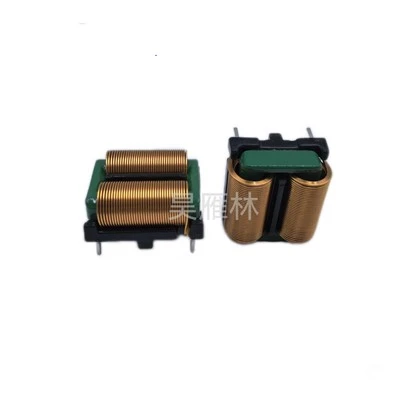
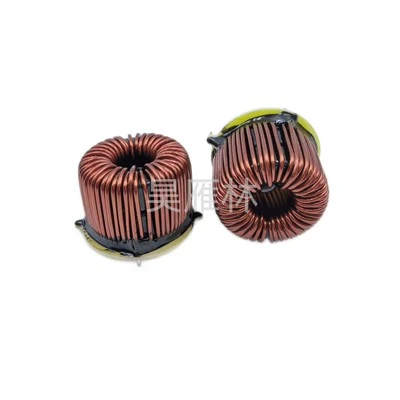
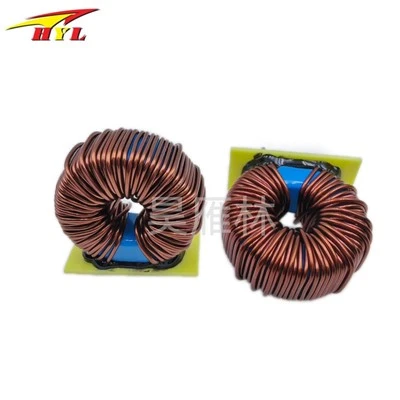
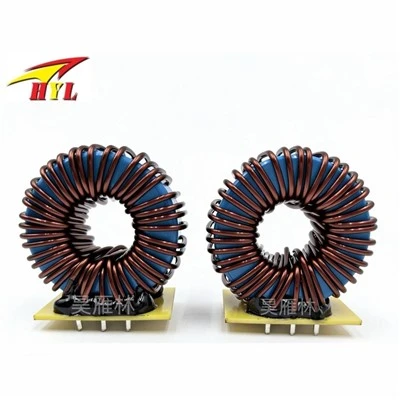
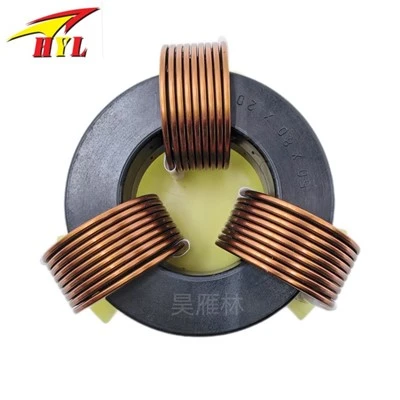
A toroidal coil inductor operates based on the principle of electromagnetic induction. When current flows through a coil wound on a toroidal magnetic core, a magnetic field is generated. This magnetic field is confined and concentrated within a closed magnetic circuit formed by the toroidal core. Energy is stored in the space surrounding the core and coil in the form of the magnetic field. When the current flowing through the inductor changes, the stored magnetic energy resists this change, thus exhibiting the characteristic of impeding the change in current, i.e., the inductance effect.
The magnitude of its inductance (L) can be calculated using formulas. Common formulas include L = N² × AL (where N is the number of turns in the coil and AL is the inductance coefficient of the core) or L = (μ × N² × A) / l (where μ is the permeability of the core, A is the cross-sectional area of the core, and l is the average magnetic path length). These formulas show that the inductance is closely related to the square of the number of turns in the coil, the permeability of the core, and its dimensions.
In practical applications, its working principle is used in various detection and control scenarios. For example, in traffic flow detection, a toroidal inductor is embedded in the road surface. When a vehicle (metal body) passes by, the inductance of the inductor changes. This inductor is then connected to an LC resonant circuit, and the change in inductance is converted into a change in the circuit's resonant frequency. By detecting the frequency, the passage of a vehicle can be sensed.