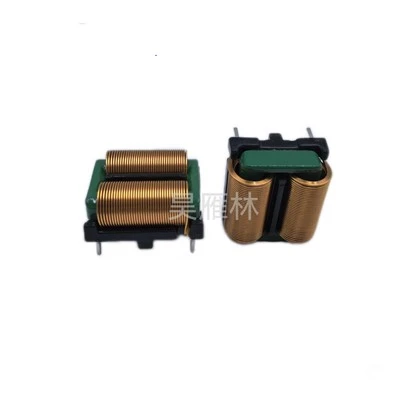
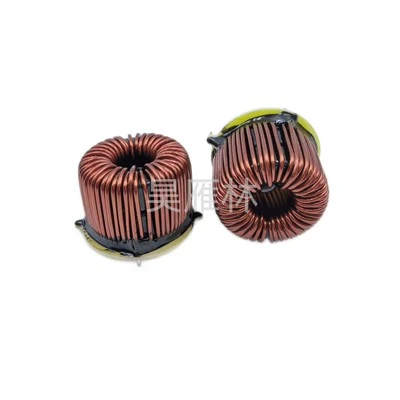
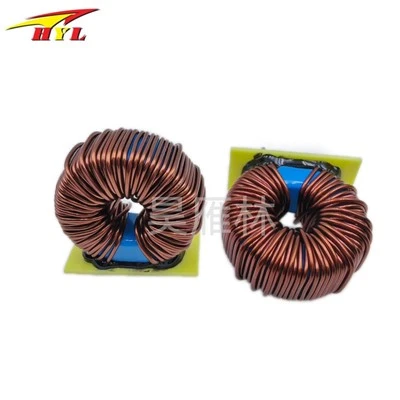
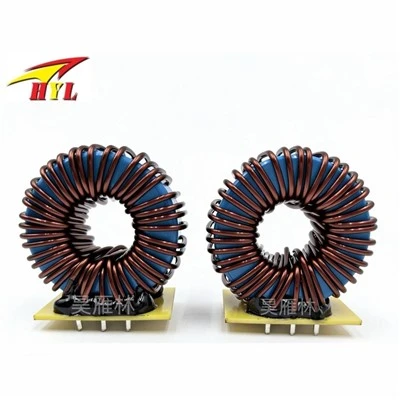
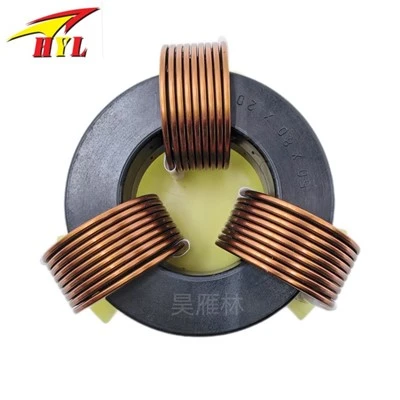
A toroidal inductor, also known as a magnetic ring inductor or toroidal coil inductor, is an inductor with a toroidal magnetic core as its core component, around which wires are wound. It efficiently stores magnetic energy using a closed magnetic circuit.
A toroidal inductor mainly consists of two parts: the magnetic core and the winding. The magnetic core is usually made of magnetic materials such as ferrite or iron powder core. Its function is to provide a closed magnetic path, guiding and concentrating the magnetic field generated by the coil, thereby increasing the inductance. The winding is usually enameled copper wire, tightly wound around the periphery of the magnetic ring. Its function is to generate a magnetic field and form a current path when current flows through it.
The toroidal structure forms an almost completely closed magnetic circuit, with minimal magnetic flux leakage. This gives toroidal inductors high efficiency, low electromagnetic interference, and suitability for high-density installations. The introduction of the magnetic core increases the inductance value, reduces magnetic leakage, and improves energy transfer efficiency.
For toroidal magnetic cores, the inductance L is usually calculated using the formula L = N² × AL, where N is the number of turns of the coil and AL is the inductance coefficient of the magnetic core, the value of which is determined by the material and size of the magnetic core.